
Fraudsters posing as Financial Conduct Authority (FCA) and retail bank staff are targeting British residents on WhatsApp, persuading them to share their phone screens during video calls before dispatching Uber taxis to collect physical bank cards and PINs. In an urgent public alert issued at 09:00 GMT on 21 November 2026, Nottinghamshire Police’s Economic and Cyber Crime Unit confirmed a sharp rise in local reports, noting that several victims have already lost hundreds of pounds.
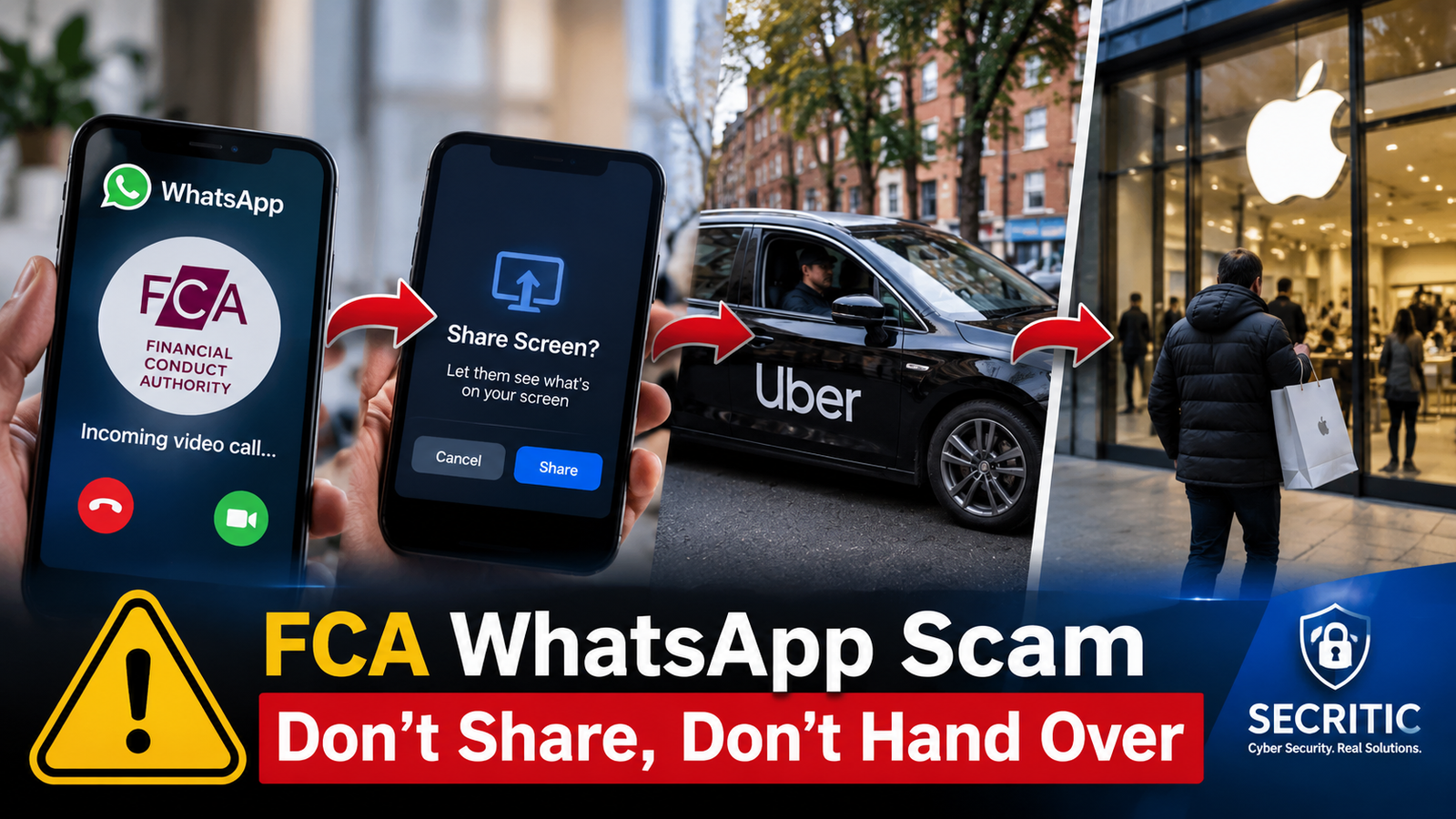
According to Fraud Protect Officer Dale Richardson, the criminals initiate contact through unprompted WhatsApp messages, voice calls, or video calls while displaying official FCA or bank logos on their profiles to appear authentic. Once callers convince victims that their bank accounts are compromised or under regulatory investigation, they persuade them to enable WhatsApp’s screen-sharing feature and later instruct them to hand over bank cards, PINs, cash, or valuables to a courier sent to their home. In multiple Nottinghamshire cases, criminals booked Uber taxis to pick up the cards and PINs, which were subsequently used in retail stores, including Apple outlets, to buy high-value goods.
While Nottinghamshire Police has confirmed financial losses running into hundreds of pounds and identified the retail spending pattern, several key details remain unestablished. Investigators have not disclosed the exact number of Nottinghamshire victims, whether any arrests have been made, or whether the Uber drivers dispatched to collect the packages were unwitting commercial contractors or complicit participants. Similar regional warnings, including a 13 November 2026 courier fraud alert from Cheshire Constabulary, point to a wider pattern across UK police force areas, though authorities have not publicly linked the separate regional investigations to a single organised crime group.
How the WhatsApp and Uber Courier Scam Works
The operation merges mobile social engineering with traditional courier fraud, guiding victims through a carefully paced sequence that begins with an unexpected digital message and ends with a physical handover on their doorstep. Rather than relying on a single technical exploit, the criminals build credibility step by step so each request feels like a logical continuation of an official fraud investigation.
Criminals begin by setting up standard WhatsApp accounts configured with corporate display names and high-resolution images of the FCA emblem or a well-known UK bank logo. Unlike traditional landline caller-ID spoofing, which requires manipulating telephone network routing digits, a messaging profile takes seconds to customise. Because WhatsApp allows any registered user to upload an arbitrary profile picture, an unsolicited message or call can appear at first glance to come from a legitimate regulatory or banking security team.
The initial contact typically arrives as a text message, audio call, or video call warning that suspicious transactions have been detected on the recipient’s account or that their savings must be moved to a safe account as part of an urgent inquiry. Escalating the interaction to a video call adds psychological weight. Even when the caller keeps their own camera switched off or displays only a static corporate crest, the visual format of a video call creates a false impression of legitimacy and accountability.
“To trick victims, fraudsters have displayed the FCA logo or bank logo to make themselves appear genuine,” Fraud Protect Officer Dale Richardson explained in the Nottinghamshire Police release. “This makes the scam feel more real and convincing so it’s really important people are aware of this tactic and to encourage friends and family to be vigilant.”
Once the caller has established authority and heightened anxiety, the deception shifts to WhatsApp’s built-in screen-sharing tool. The impersonator asks the victim to share their mobile display so a supposed investigator can check security settings, verify account activity, or help block unauthorised transfers. During a live screen-sharing session, whatever renders on the victim’s phone screen is transmitted in real time to the caller.
From a technical standpoint, screen sharing carries real risks without giving the attacker complete, automatic control over the device. Many modern mobile banking apps use operating system privacy flags to block screenshots and black out sensitive screens during active screen recording, which can hide account balances or password fields. However, screen sharing does not protect everything on a smartphone.
Depending on the device’s operating system, notification settings, and which apps the victim opens, a caller watching a shared screen may be able to read incoming SMS one-time passcodes in banner previews, view email security alerts, see personal details in non-protected apps, or coach the victim step by step through banking menus. Nottinghamshire Police warned that screen sharing during these calls risks fraudsters obtaining sensitive information or accessing online banking, though police have not published forensic records detailing which specific apps were visible in individual local cases.
In the final phase of the scam, the caller tells the victim that their existing bank card has been compromised or is required as physical evidence for an investigation. The victim is instructed to place their debit or credit card, along with their written PIN, cash, or valuables, into an envelope for collection. Rather than sending an accomplice to knock on the door, the fraudsters use a ride-hailing app to book an Uber taxi from the victim’s home address to a separate drop-off point.
In ride-hailing courier scams, a licensed private-hire driver receives what appears to be a routine parcel or passenger pickup request and may have no knowledge that the sealed envelope contains stolen payment cards. Once the package reaches the drop-off location, accomplices retrieve the card and matching PIN and head immediately to high-value retail outlets. In the Nottinghamshire cases confirmed by police, criminals used the collected cards and PINs in stores, including Apple, to purchase goods before the victim realised the call was fraudulent and froze the account.
A Wider UK Pattern of Courier and Impersonation Fraud
The Nottinghamshire Police warning arrives amid documented courier fraud activity across multiple UK regions and national data showing how persistent physical collection scams remain despite stronger digital banking controls. Examining comparable incidents helps clarify how fraud groups refine their scripts while keeping the underlying collection model intact.
Just eight days before Nottinghamshire Police issued its alert, Cheshire Constabulary warned residents about fraudsters impersonating FCA staff via phone calls and WhatsApp messages bearing the FCA logo. In the Cheshire cases, victims were instructed to withdraw cash, hand over valuables, or surrender bank cards and PINs for collection by Uber taxis, resulting in three successful thefts totalling roughly £10,000. Earlier in the year, Leicestershire Police praised a quick-thinking Uber driver in Earl Shilton who had been booked to deliver an envelope from a woman in her eighties to an address in London. Suspecting the envelope contained the woman’s bank card after a bank-impersonation call, the driver alerted officers, allowing police to safeguard the victim before any money was stolen.
National figures underscore the scale of the threat across Britain. According to Report Fraud’s June 2026 courier fraud analysis, reports of courier fraud across the UK rose by 10 percent in 2025 to 1,891 cases, with total losses exceeding £21 million and an average loss of £15,311.08 per victim. Report Fraud noted that criminals frequently use WhatsApp and commercial courier services to collect cash, cards, or high-value items such as gold and jewellery, with people aged 76 to 96 accounting for 62 percent of reported victims.
Broader industry statistics show why criminals continue adapting their lures. The UK Finance Annual Fraud Report 2026 recorded £1.28 billion in total fraud losses across 4.06 million cases in 2025, including £55.5 million lost specifically to police and bank impersonation scams. While overall bank and police impersonation losses declined by 12 percent year on year as retail banks introduced stricter payment warnings and confirmation prompts, fraudsters have responded by shifting toward regulatory impersonation and third-party taxi collections that bypass bank transfer delays.
Cybersecurity Analysis: Why Combining Digital Impersonation with Physical Collection Works
From a cybersecurity perspective, this scam illustrates how criminals adapt when technical defences become harder to defeat. Over the past several years, retail banks have rolled out biometric authentication, cryptographic device binding, and Strong Customer Authentication for online payments and mobile transfers. Breaking those technical controls remotely requires sophisticated malware or credential-harvesting infrastructure that frequently triggers automated bank fraud blocks. Courier fraud sidesteps those digital barriers entirely by persuading the legitimate account holder to surrender the physical chip card and four-digit PIN required for face-to-face retail spending.
Impersonating the Financial Conduct Authority exploits a specific gap in public understanding. Many British consumers have absorbed the warning that their bank will never ask for their PIN over the phone, so scammers present themselves as a higher regulatory authority investigating misconduct or systemic vulnerabilities inside the banking sector. According to the Financial Conduct Authority’s official guidance on fake communications, the regulator never asks consumers to transfer money or share banking passwords and PINs, and it never uses WhatsApp or other messaging apps to contact individuals. In reality, the FCA supervises financial firms and markets rather than monitoring individual personal bank accounts or intervening in customer disputes. Any unexpected WhatsApp message or video call claiming to come from an FCA investigator is therefore fraudulent by definition.
It is equally important for readers to understand what WhatsApp screen sharing actually does and what it cannot automatically accomplish. Ordinary screen sharing lets another call participant see what is displayed on your screen, much like someone standing behind your shoulder. It is not a remote access Trojan, and activating screen sharing during a WhatsApp call does not silently install malware, grant hidden background control over your handset, or automatically bypass every banking security boundary. The real danger lies in two areas: visual exposure of live notifications or unprotected screens, and real-time psychological manipulation. When a scammer can see what is on your screen, they can react immediately to error messages, guide you step by step through settings, and maintain the illusion that they are running a live diagnostic scan on your account.
Outsourcing the physical collection to ride-hailing drivers solves another operational problem for fraud syndicates. Historically, courier fraud required sending a human collector directly to a victim’s doorstep, exposing that accomplice to doorbell cameras, neighbours, and rapid police identification. By booking a legitimate ride-hailing trip from the victim’s address to a public meeting point, criminals insulate themselves from doorstep CCTV while exploiting commercial logistics built for speed and convenience. The Leicestershire Police case demonstrates that vigilant drivers can disrupt this chain, yet consumers cannot rely on a courier to spot a crime in progress. The safest defence is ending the conversation before a card ever leaves your hand.
How to Stay Safe: Practical Steps for UK and International Readers
Protecting yourself against messaging-based courier fraud requires clear rules around unsolicited contact, screen sharing, and physical payment cards. Although the November 2026 alerts were issued by UK police forces, scammers use identical WhatsApp screen-sharing and courier tactics across Europe, North America, and other regions.
Recognise the Red Flags Immediately
Treat any unexpected WhatsApp message, voice call, or video call claiming to be from the FCA, your bank, or the police as a scam. Neither financial regulators, commercial banks, nor law enforcement agencies initiate fraud investigations through WhatsApp, ask you to share your mobile screen, or send couriers and taxis to collect bank cards, PINs, cash, or valuables. Do not rely on a caller’s profile picture, corporate logo, or calm tone as proof of identity, and never allow a caller to rush you into acting before speaking with a trusted family member or friend.
End the Call and Verify Independently
If you receive a call warning that your bank account is at risk, hang up immediately without arguing or following instructions. To check whether a genuine issue exists, contact your bank using an independent, trusted channel that you initiate yourself.
In the UK, dial 159, the memorable short code operated by Stop Scams UK that connects customers of more than 99 percent of UK retail bank current accounts directly to their bank’s legitimate fraud team. Stop Scams UK confirms that 159 cannot be spoofed or impersonated by criminals. Alternatively, call the customer service number printed on the back of your debit or credit card. If you were speaking on a landline, wait at least five minutes or use a mobile phone before dialling so you know the previous line has fully cleared. Outside the UK, hang up and dial the official telephone number printed on the reverse of your payment card or listed on your bank’s official website.
Harden Your WhatsApp Privacy and Account Settings
You can reduce the likelihood of unsolicited scam calls reaching you by adjusting WhatsApp’s built-in privacy and account security controls:
- Silence unknown callers: According to the WhatsApp Help Center, open WhatsApp, tap More Options (the three vertical dots on Android) or Settings (on iPhone), go to Settings > Privacy > Calls, and toggle on Silence unknown callers. Calls from numbers not saved in your contacts will no longer ring your phone, though they remain visible in your Calls tab in case a legitimate contact tried to reach you.
- Restrict group invitations: Open Settings > Privacy > Groups and select My Contacts so fraudsters cannot drop your number into fake banking, regulatory, or investment alert group chats.
- Enable two-step verification: Turn on WhatsApp two-step verification by navigating to Settings > Account > Two-step verification and creating a six-digit PIN. This prevents criminals from hijacking your WhatsApp account on another device even if they manage to intercept a registration code.
What to Do If You Shared Your Screen or Handed Over a Card
If you have already shared your screen during a suspicious video call or handed a bank card to a courier or taxi driver, take the following actions immediately:
- Freeze or cancel your cards first: Open your mobile banking app directly or call your bank’s emergency fraud line (or 159 in the UK) to block compromised cards, cancel pending transactions, and secure your online banking profile.
- Reset exposed credentials if needed: If you opened your banking app, viewed one-time passcodes, or typed passwords while screen sharing was active, inform your bank’s fraud team so they can reset your online banking security credentials and monitor for unauthorised logins.
- Contact emergency services if a collection is underway: In the UK, if a courier or taxi is currently on the way to your home or has just left with your card, call 999 immediately so officers can intercept the vehicle or trace the drop-off destination.
- Report the crime and preserve evidence: If the incident has already taken place in England, Wales, or Northern Ireland, report it to your local police force on 101 and submit a report through Report Fraud online or by calling 0300 123 2040. In Scotland, report directly to Police Scotland on 101. You can also report suspicious WhatsApp accounts inside the app by opening the chat, tapping the contact name, and selecting Report, and forward suspicious text messages or scam phone numbers for free to 7726 in the UK. International victims should report the incident to local law enforcement and their national cybercrime reporting agency, such as the FBI Internet Crime Complaint Center (IC3) in the United States.
- Save details for investigators: Take screenshots of the caller’s WhatsApp profile, phone number, and chat history, and write down the exact pickup time, vehicle details, or booking references so police can follow the investigative trail.

Community discussion
Join the conversation
0 comments
Be the first to join in
There are no comments yet. Sign in to start a thoughtful discussion.
Sign in to comment
Join the conversation with your Secritic account. Comments are available to signed-in readers.