
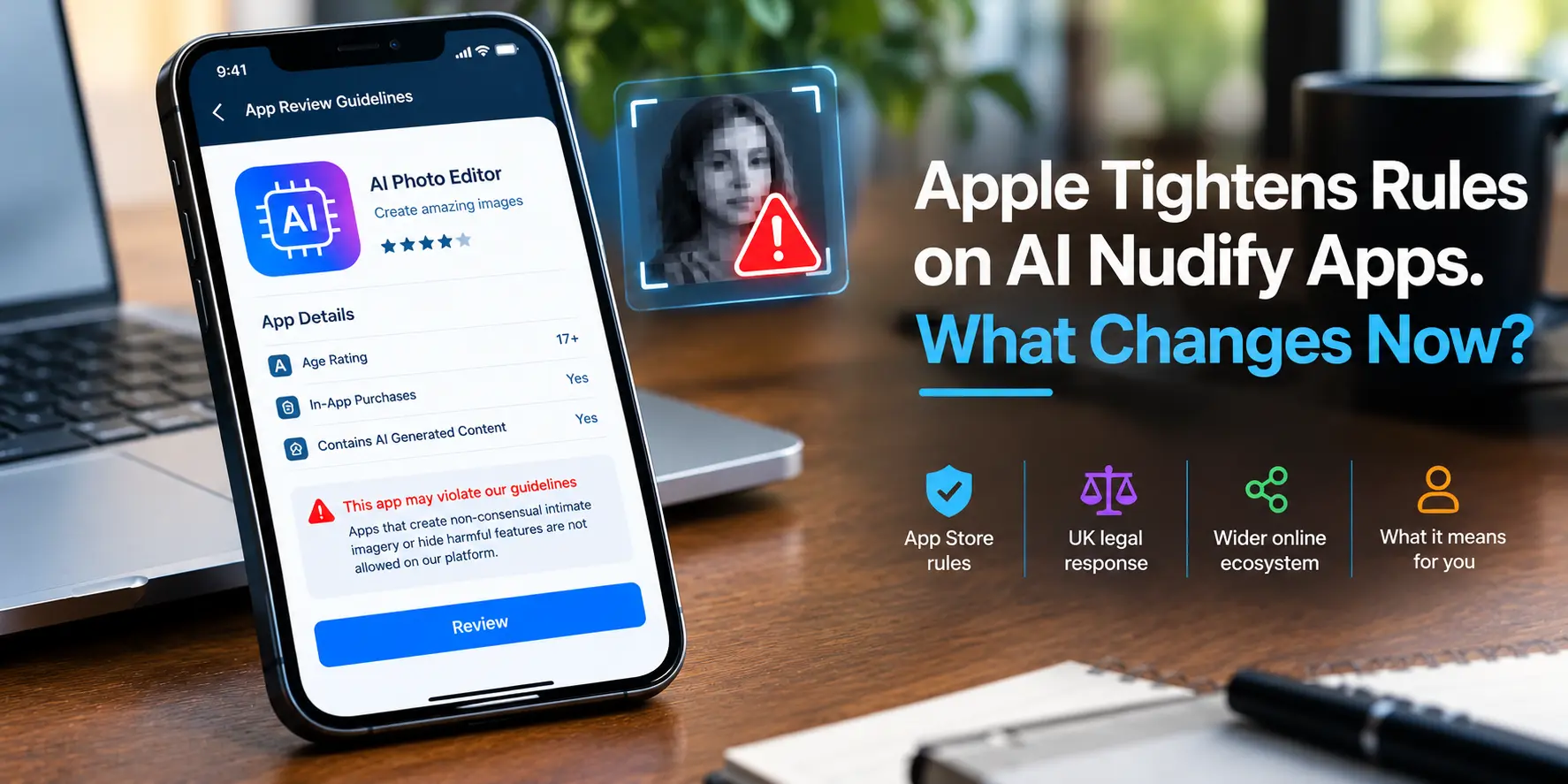
Apple has updated its App Store review rules to make its position on AI-powered “nudify” apps clearer. These tools can create sexualised or intimate images of real people without their consent. The change matters, but it raises a bigger question: how much difference can app store rules make when these tools are promoted and used across the wider internet?
Announced on 16 October 2026, Apple’s update strengthens its guidance on non-consensual intimate imagery and apps that hide harmful features during the review process. Here is what changed, how it fits into the wider problem, and what would show whether the rules are working.
What has Apple changed?
Apple says sexually explicit material has long been prohibited on the App Store, including apps that generate sexualised images of real people without consent. The October update makes the relevant rules more explicit.
Under its updated Guideline 1.2, apps that host user-generated content must take steps to filter objectionable material, allow users to report it, and let them block abusive accounts. Apple also says developers who fail to put appropriate safeguards in place, or fail to address violations after being notified, may face action under its Developer Code of Conduct.
The update also clarifies Guideline 2.5.19, which addresses hidden, dormant or undocumented features. An app must not present itself one way during Apple’s review and then reveal prohibited capabilities after approval. This practice is often described as a “bait-and-switch”.
The important distinction is that Apple has not suddenly made every form of AI image generation prohibited. The focus here is on prohibited content, non-consensual intimate imagery, inadequate safeguards and deceptive app behaviour. Apple’s announcement explains the changes.
The problem extends beyond the App Store
Research published by the Institute for Strategic Dialogue (ISD) in July 2026 describes a wider ecosystem of tools and services. People may discover these tools through search results or social media, use commercial apps or other technical systems to generate images, and then share or promote content through messaging services and affiliate networks.
That means no single company controls every stage.
A separate report by WIRED, drawing on ISD research, found that social media platforms referred more than 5.7 million visits to ten selected nudify services between December 2025 and March 2026. YouTube accounted for 1.82 million referrals, while X accounted for more than 1.3 million.
These figures need careful interpretation. They describe visits referred to a selected group of services during a specific period. They do not represent 5.7 million unique people, nor do they prove that every visitor created or shared an abusive image. They do, however, illustrate why the pathways leading people to these tools deserve scrutiny.
Read the ISD research and WIRED’s reporting.
Digital rights · Explainer
How the AI nudify app ecosystem works
Harmful intimate imagery can involve more than one app or website. Different services may play different roles, from helping people discover tools to enabling image creation, distribution or promotion.
Discovery
Search results, social posts, videos or promotions may direct people towards a service.
Access and creation
A website, app or other technical tool may be used to generate or facilitate non-consensual intimate imagery.
Sharing and circulation
Images or links may move between websites, social networks and messaging services.
Promotion and revenue
Some operators may use referrals, affiliate networks or payment systems to promote or monetise services.
App stores and platforms
Review apps, detect prohibited features, provide reporting tools, investigate violations and take action under platform policies.
Law and enforcement
Apply relevant legislation to conduct within its scope, investigate suspected offences and pursue appropriate legal action.
Hosting and other services
Where applicable, assess abuse reports and address the infrastructure, distribution or payment services supporting harmful activity.
How does UK law fit in?
Apple’s rules govern access to its platform. UK law addresses a different part of the problem.
Section 99 of the Crime and Policing Act 2026 provides for an offence involving making or adapting, supplying, or offering to supply a tool for use as a generator of purported intimate images. The provision came into force on 29 June 2026. It includes a defence where the person charged can prove that they took all reasonable steps to prevent the tool being used to create such images without consent.
This is not the same as Apple’s app review process. The law concerns conduct covered by the legislation; Apple decides whether an app meets its platform rules. Neither measure, on its own, proves that harmful tools have disappeared or that enforcement is consistently effective.
What would show whether the rules are working?
The clearest evidence would be more than an announcement or a list of removed apps. It would include information about how quickly reports are handled, whether repeat offenders return under different names, whether harmful features are detected before approval, and whether users can still easily find services that facilitate abuse.
It would also be useful to know how Apple responds when a violation is reported and whether its actions lead to lasting changes rather than temporary removals. These are questions for ongoing scrutiny, not results that can be assumed from the policy update alone.
The wider ecosystem matters too. If one route is closed but promotion, hosting, payments or distribution continue elsewhere, the problem may simply move. That is why coordination between app stores, social platforms, service providers, payment companies and law enforcement is important.
What should someone do if an intimate image is created without consent?
Do not assume that reporting it to one company will remove it everywhere. Where it is safe to do so, keep records of the relevant account, URL, date and report reference. Report the content to the service hosting it, and consider seeking help from an appropriate support organisation or law enforcement. Avoid resharing the image, even to draw attention to the abuse.
The real test is enforcement
Apple’s update makes its expectations clearer, while UK legislation provides another route for addressing tools designed to generate non-consensual intimate images. Both are significant parts of the response, but neither is proof that the wider problem has been solved.
The real test will be whether these measures make harmful tools harder to find, harder to operate and harder to use against people without their consent. That will require consistent enforcement and evidence over time, not just stronger wording in a policy.



Community discussion
Join the conversation
0 comments
Be the first to join in
There are no comments yet. Sign in to start a thoughtful discussion.
Sign in to comment
Join the conversation with your Secritic account. Comments are available to signed-in readers.