
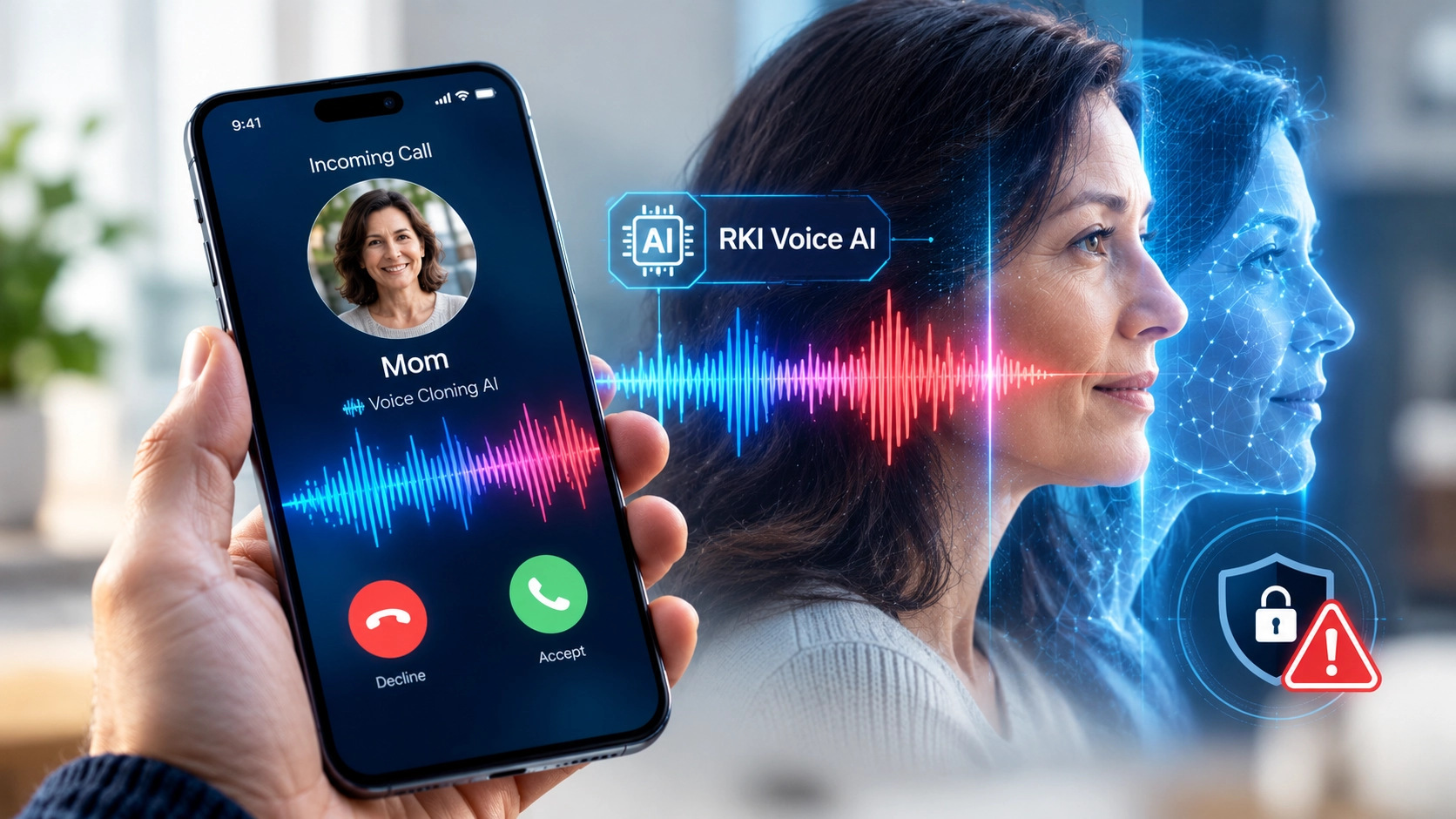
A phone call from your child, partner, friend or colleague can be difficult to question when the person sounds frightened and says they urgently need help. But what if the voice you recognise is being imitated, or the face on your screen is part of a fake video?
Scammers can use artificial intelligence (AI) to generate or manipulate audio, images and video. They may use this material to impersonate a relative in an emergency, pose as a colleague requesting a business payment, or make a fake identity appear more convincing. The aim is often to exploit trust and fear before the recipient has time to check the story.
On 19 October 2026, INTERPOL published an awareness campaign about scams involving AI-generated or AI-altered media. Its examples included a supposed family member in trouble and a supposed colleague asking for a bank transfer. The organisation advises people to pause and verify unexpected requests through a trusted channel rather than relying on what they hear or see.
The danger is not that every call could be fake. It is that a convincing voice or video can no longer be treated as sufficient proof of identity. Before sending money or sharing sensitive information, you need to establish who is contacting you and whether their request is genuine.
How AI voice and deepfake scams work

AI voice scams can begin with a criminal collecting publicly available material, such as recordings, photographs or videos of a real person. AI tools can then be used to generate or alter media that imitates that person’s voice or appearance.
The results vary by tool and circumstances. There is no single amount of source material that guarantees a successful imitation, and not every scammer uses AI. Some rely on ordinary impersonation, stolen accounts, spoofed contact details or fabricated stories.
In a family emergency scam, the criminal might contact someone claiming to be their child or another relative. They could say they have been in an accident, have been arrested or are stranded and need money immediately. A convincing voice imitation may make the story seem more credible.
Other schemes target workplaces. A caller or video participant may pose as a manager, executive or supplier and request an urgent transfer or a change to payment details. The FBI’s Internet Crime Complaint Center (IC3) has warned about AI-generated videos used to impersonate public figures and promote fraudulent schemes, including scams that target people who have already lost money.
AI can help make an impersonation more convincing, but the underlying method is familiar: the scammer presents a false identity or story and tries to get the recipient to act before verifying it.
Why a familiar voice or face is no longer enough
People naturally use a person’s voice, face and manner of speaking to recognise them. A familiar voice can therefore feel like convincing evidence that a call is genuine.
That assumption can be dangerous.
In a March 2023 consumer alert, the US Federal Trade Commission (FTC) warned that scammers could use a short audio clip found online to create a voice imitation for a family emergency scheme. The FBI’s December 2024 advisory also described criminals using AI-generated audio to impersonate relatives and seek urgent financial assistance.
These warnings do not mean that AI can perfectly imitate every person in every situation. They show that hearing a familiar voice is not a reliable identity check on its own.
There is another important distinction: a real voice does not guarantee a genuine request. Someone could be using a compromised account, a stolen phone or another person’s identity. A real person might also be under pressure or manipulated by someone else.
The safest approach is to verify both the person’s identity and the request independently.
Why traditional scam warning signs are becoming less reliable
Traditional scam warnings, such as spelling mistakes, poor formatting and inconsistent branding, can still be useful. However, they are no longer reliable enough to judge whether a message, call or video is genuine.
Toshinobu Yasuhira, Director of the INTERPOL Innovation Centre, highlighted this change when INTERPOL launched its public awareness campaign on AI deepfake scams on 19 October 2026.
“AI is erasing the tell-tale signs of a scam. Spelling mistakes, branding inconsistencies, clumsy formatting: these red flags are fast becoming a thing of the past,” Yasuhira said.
His warning reinforces an important point: a convincing voice, professional-looking message or realistic video should not replace independent verification. If someone asks you for money, account information or urgent action, contact them through a separate, trusted channel before responding.
Source: INTERPOL — AI deepfake scams awareness campaign, 19 October 2026.
Warning signs of an AI voice scam
There is no single sign that proves a call uses AI. Instead, look at the circumstances, the requested action and the caller’s response when you try to verify the story.
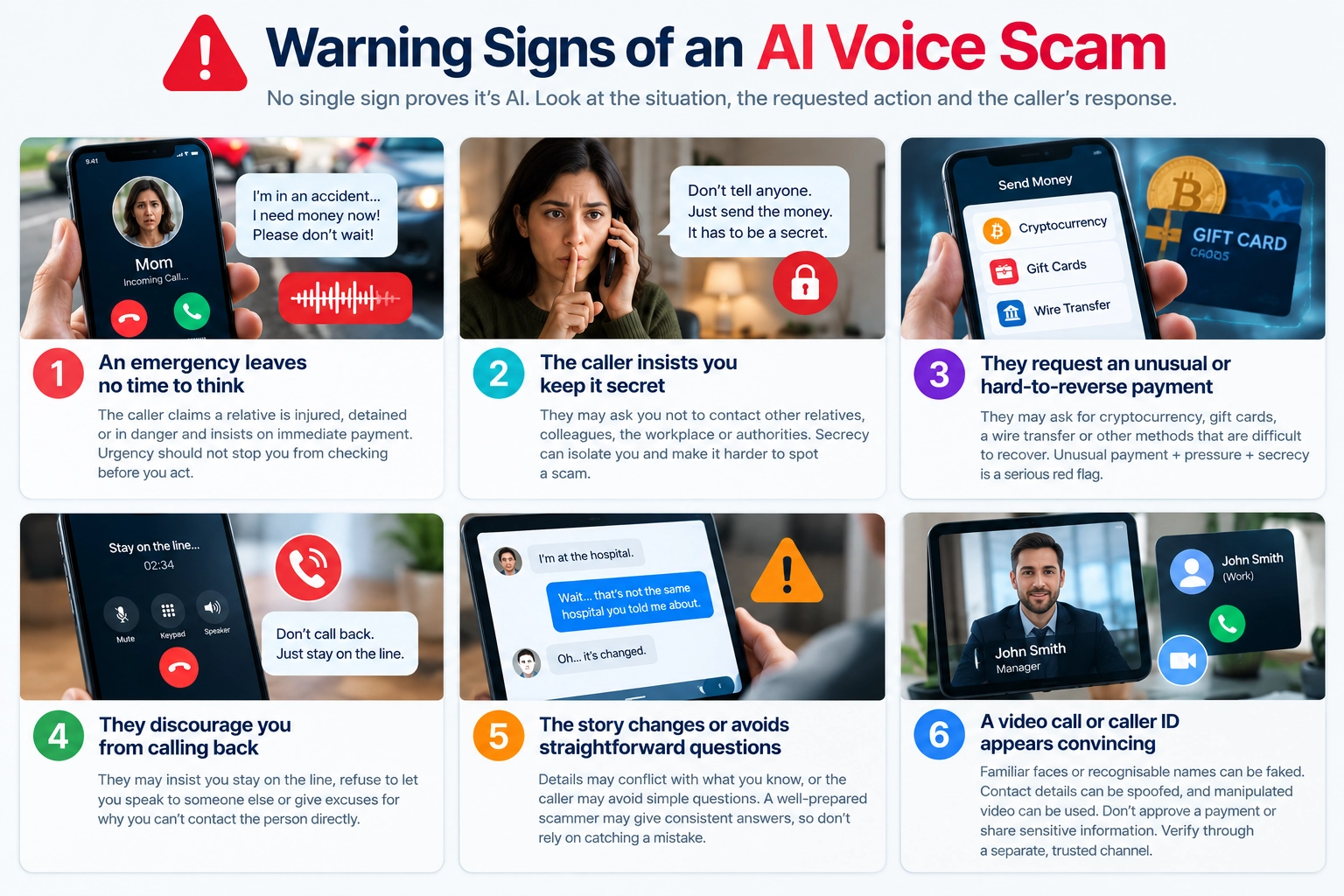
1. An emergency leaves no time to think
The caller claims that a relative has been injured, detained or placed in danger. They insist that money must be sent immediately and suggest that even a brief delay will make the situation worse.
Genuine emergencies can be urgent. However, urgency should not prevent you from making independent checks before transferring money.
2. The caller insists that you keep it secret
They tell you not to contact other relatives, a colleague, the person’s workplace or the authorities. This may be presented as a way to avoid embarrassment or prevent the situation from getting worse.
Secrecy can isolate you from people who might identify the deception. Be cautious when a request for urgent help comes with instructions not to verify it with anyone else.
3. They request an unusual or hard-to-reverse payment
The caller asks for cryptocurrency, gift cards, a wire transfer or another payment method that may be difficult to recover. The US Consumer Financial Protection Bureau (CFPB) identifies these among the payment methods commonly exploited in scams.
The payment method alone does not prove that a request is fraudulent. But an unusual payment combined with pressure, secrecy and an unverified identity is a serious reason to stop and check.
4. They discourage you from calling back
The caller says you must stay on the line, refuses to let you speak to someone else or offers excuses for why you cannot contact the supposed victim directly.
Do not treat the caller’s explanation as proof. End the conversation if necessary and use contact details you already trust.
5. The story changes or avoids straightforward questions
Details may conflict with what you know, or the caller may avoid simple questions about the situation. These inconsistencies can be useful warning signs.
But the opposite is not proof of safety: a well-prepared scammer may give consistent answers. Do not rely on catching a mistake to decide whether to trust a caller.
6. A video call or caller ID appears convincing
A familiar face on screen or a recognisable name on caller ID can create a false sense of security. Contact details can be spoofed, and manipulated video can be used in impersonation schemes.
Do not approve a payment or disclose sensitive information simply because the person looks or sounds familiar. Verify the request through a separate, trusted channel.
What to do if someone you know calls asking for money
If a caller claims to be a relative, friend or colleague in trouble, do not send money while you are still trying to establish whether the story is true.
Step 1: Pause before acting
Take a moment to think. Do not let fear, urgency or a demand for secrecy make the decision for you. If the caller is pressuring you, that is a reason to verify the request, not a reason to skip verification.
Step 2: Hang up and contact the person independently
Call the person using a number already saved in your contacts or another communication method you know is genuine. Do not rely on a number, link or contact detail supplied by the suspicious caller.
If the person does not answer, try another trusted relative, friend or colleague who may be able to confirm the situation.
Step 3: Verify the emergency through another source
If the caller claims that someone has been injured, arrested or is in immediate danger, seek independent confirmation where possible. For a genuine emergency, contact the relevant emergency service or authority using official contact details you obtain independently.
Do not assume that sending money is the fastest or safest way to help.
Step 4: Agree on a family safe word
INTERPOL recommends establishing a secret word or phrase with close family members or friends to help verify identity during suspicious calls.
Choose something that is not publicly posted or easy to guess, and agree on how to use it. A safe word is an extra layer of protection, not a guarantee: it can be disclosed, guessed or compromised. Continue to verify unusual requests independently.
Step 5: Check business payments through established procedures
If a supposed manager, executive or supplier asks for a transfer or changes to bank details, confirm the request through an established workplace contact or a separate, trusted channel.
Businesses should use multi-step approval and verification for financial transactions, especially large or unusual transfers. A voice call or video meeting should not override normal payment controls.
Step 6: Protect your accounts
If the caller asks for passwords, verification codes, banking details or other sensitive information, do not disclose them. If you suspect an account has been compromised, use the service’s official recovery process and secure the account. Enable two-factor authentication where available.
What if you have already sent money?
Act as soon as possible. Contact your bank, card issuer or payment provider using its official contact details. Explain that the payment may be connected to fraud and ask whether it can be stopped, recalled or disputed.
Recovery is not guaranteed. The available options depend on the payment method, timing and circumstances, but contacting the provider quickly gives you the best chance of finding out what action is possible.
Preserve evidence that may help an investigation, including:
- The caller’s number and any account or profile details.
- Messages, emails, links and call times.
- Payment receipts and transaction references.
- The instructions the caller gave you.
- Any recordings or screenshots you already have, where lawful to retain.
Do not delete relevant messages before preserving useful evidence. Report the incident to the appropriate police or fraud-reporting service in your country.
Be particularly careful if someone later promises to recover your money for an upfront fee. The FBI’s IC3 warned in July 2026 that scammers were impersonating law-enforcement personnel and using AI-generated videos as part of schemes that targeted previous fraud victims. The IC3 states that it does not charge people to recover lost funds.
A person who claims to be a recovery agent, investigator or official is not automatically genuine. Verify their identity through the relevant organisation’s official website or contact details before sharing information or paying anything.
Can you tell whether a voice or video is AI-generated?
Sometimes a recording or video contains visible or audible inconsistencies. The FBI has advised people to look for irregular facial features, unnatural movements, unusual shadows and other possible clues in manipulated media.
However, these clues are not a dependable test for every recording or live interaction. Their absence does not prove that a video is genuine, and an unusual voice or visual glitch does not prove that AI was used.
AI detection tools may help assess some material, but their results depend on the content and the technology involved. Do not treat a detector’s result as definitive proof of identity.
For most people, independent verification is more practical than trying to conduct a technical examination during an urgent call. You do not need to identify every deepfake to protect yourself. You need to avoid making important decisions until you have checked who is contacting you and whether the request is legitimate.
How to prepare before a scam happens
A few precautions can make impersonation attempts harder to carry out successfully.
- Agree on an emergency verification plan. Discuss with family members how to check an urgent request and whom to contact if someone cannot be reached.
- Keep trusted contact details available. Make sure you can reach relatives and colleagues without relying on details provided during a suspicious call.
- Limit unnecessary public personal information. Public posts may reveal relationships, workplaces, travel plans and other details that a scammer could use to make a false story more convincing.
- Verify payment changes independently. Confirm new bank details and unusual transfer requests through established procedures, particularly in the workplace.
- Secure online accounts. Enable two-factor authentication where available and keep devices and applications updated.
- Talk to relatives who may be unfamiliar with these tactics. Explain that a convincing voice, video or caller ID does not prove identity, and encourage them to pause before sending money.
These precautions cannot prevent every impersonation attempt. Their purpose is to create time for verification and reduce the chance that a convincing story leads directly to a payment.
The bottom line
AI voice scams and deepfake videos can make impersonation more convincing, but the danger lies in what the scammer persuades you to do: trust an unverified identity, keep the situation secret or send money before checking the facts.
Official warnings from INTERPOL, the FTC and the FBI document the use of AI-generated or manipulated media in impersonation and fraud. They do not establish that every suspicious call uses AI, and there is no single visual or audio clue that reliably exposes every deepfake.
If someone you know appears on a call and urgently asks for money, do not treat a familiar voice or face as proof. Hang up, contact the person through a trusted channel and verify the situation independently. If you have already paid, contact your bank or payment provider promptly and report the incident through the appropriate official channel.
A convincing voice can create trust. Independent verification helps protect your money.
Sources
Official guidance and resources used in this article.
Editorial note: This article provides general fraud-prevention information. Reporting procedures and payment-recovery options differ by country and payment method. Readers should use the official police, fraud-reporting and financial-service channels in their jurisdiction.



Community discussion
Join the conversation
0 comments
Be the first to join in
There are no comments yet. Sign in to start a thoughtful discussion.
Sign in to comment
Join the conversation with your Secritic account. Comments are available to signed-in readers.