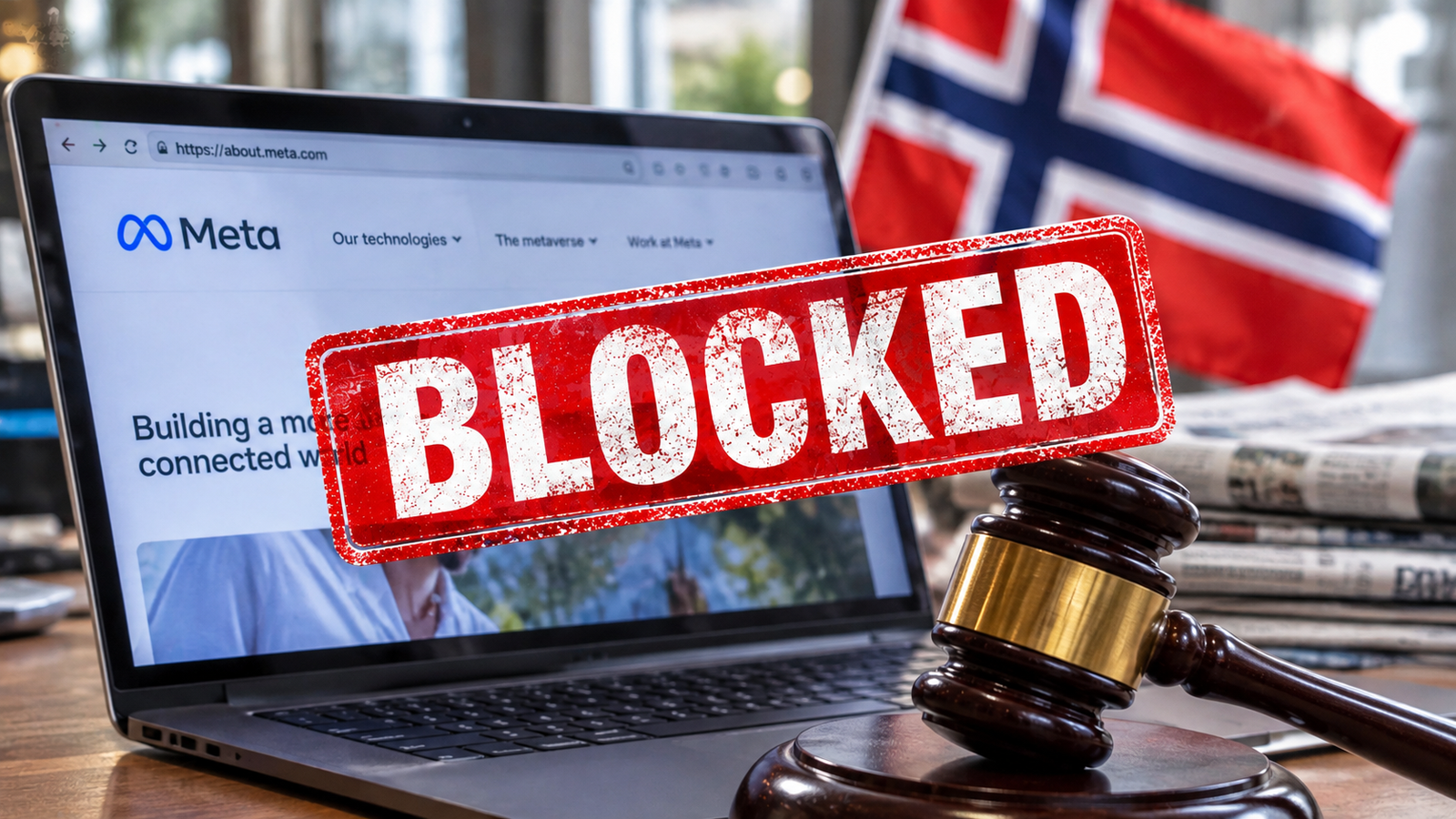
A Norwegian court has temporarily blocked Meta from introducing disputed changes to its business terms after ten media organisations challenged the company.
The dispute concerns Meta’s proposed permission to collect content from websites connected with business accounts. Publishers fear losing control over their articles, photographs and other original work.
Meta has also delayed the rollout while it consults industry groups. Here is what happened, why publishers object and what the court decision actually means.
What Are Meta’s New Business Terms?
Businesses use Facebook and Instagram to advertise products, manage professional pages and connect with customers. Many also operate their own websites, where they publish articles, photographs, videos and product information.
Meta’s proposed changes concern its Commercial Terms and Self-Serve Ad Terms. These agreements apply to people and organisations using Meta products for business and advertising purposes.
The disputed wording authorises Meta to use automated tools, including web crawlers, bots and scrapers, to access, index, analyse and collect content from websites associated with a business’s products or services. It also refers to periodically collecting updated information from those websites.
Web crawling is a normal part of the internet. Search engines use automated crawlers to discover and organise web pages. The concern in this case is the breadth of the permission in Meta’s proposed business terms and how the collected material could be used.
Why Are Publishers Fighting Back?
A publisher’s website contains years of reporting, photographs, videos and other work that takes time and money to produce. Some of that material is available only to paying subscribers.
Norwegian media organisations fear that accepting Meta’s proposed terms could give the company broad permission to collect material from websites associated with their business accounts, including content behind paywalls.
Their concerns go beyond artificial intelligence. They also involve copyright, licensing, editorial control and whether publishers have a meaningful choice when they depend on a major platform to reach readers.
Meta has rejected the suggestion that its terms give it unlimited rights over publishers’ content. It says the crawling provisions relate to its advertising and business products and that website owners can use a robots.txt file to communicate their crawling preferences.
Meta revised the disputed wording in October, removing an explicit reference to training from the list of permitted uses. However, the crawling permission remained. Publishers and legal commentators continued to question whether the revised wording sufficiently limits how collected material could be used.
Important distinction: The explicit reference to training was removed from the revised clause, but that does not settle the wider disagreement about the possible uses of collected content. Meta and the publishers have different interpretations of the terms.
How the Meta Dispute Developed
The disagreement moved from questions about the proposed wording to industry complaints, a delayed rollout and legal action in Norway.
Meta announces changes to its business terms
Meta announces proposed updates to its commercial terms, initially scheduled to take effect on 30 October. The changes include provisions concerning automated access to websites associated with business accounts.
Publishers’ concerns receive wider attention
Nieman Lab reports on the proposed crawling provisions. The wording attracts criticism because it appears to give Meta broad permission to collect content from websites connected with business accounts.
Meta revises the disputed wording
The explicit reference to training is removed from the clause. However, the permission to crawl associated websites remains, and questions continue about the scope of the revised language.
Industry groups raise concerns with regulators
Publishers and digital advertisers increase pressure on Meta, raising concerns with competition authorities in the European Union and the United Kingdom about the proposed terms and their possible effects on businesses and content owners.
Meta postpones the planned rollout
Meta moves the planned effective date from 30 October to 20 November. The company says it needs more time to explain the changes to partners and stakeholders.
Ten Norwegian media organisations take legal action
The organisations ask Oslo District Court for a temporary injunction to prevent Meta from introducing the disputed changes. They argue that the terms threaten their control over journalism and other material published on their websites.
Oslo District Court grants a temporary injunction
The court prohibits Meta Platforms Ireland from implementing the disputed changes until their legality has been finally determined. The decision is an interim legal measure, not a final judgment.
Meta announces a further delay for consultation
Meta says it will not implement the updated terms until it has completed a full consultation with industry groups and leaders. The consultation could continue beyond 20 November, and the existing terms will remain in place in the meantime.
Which Norwegian Organisations Challenged Meta?
The legal action involved ten Norwegian media organisations:
- NRK, Norway’s public broadcaster
- TV 2
- Schibsted
- Amedia
- Polaris Media
- Aller Media
- Dagens Næringsliv
- Mentor Medier
- NTB, a Norwegian news agency
- Hordaland Folkeblad
The Norwegian Media Businesses’ Association supported the action. It welcomed the court’s decision and said the dispute was important for protecting editorial content that publishers have invested years in creating.
What Did the Court Actually Decide?
Oslo District Court granted a temporary injunction prohibiting Meta Platforms Ireland from implementing the disputed changes to its commercial terms until their legality has been finally determined.
This is an important legal development, but it should not be confused with a final ruling. The court has not permanently banned Meta’s business terms or settled every copyright and AI-related question raised by the publishers.
The order was issued without Meta first being heard at a court hearing. Norwegian court reporting states that the parties and anyone affected by the order can request a subsequent oral hearing.
The decision relates to the Norwegian legal proceedings. It should not be described as a worldwide ban or as proof that every business using Meta is automatically covered by the same legal protection.
What the decision means: Meta is temporarily prohibited from introducing the disputed changes covered by the Norwegian court order. The legality of those changes remains to be determined.
What Is Meta Doing Now?
The court order is not the only reason the proposed changes are on hold. On 28 October, Meta separately announced that it would delay implementation while it consults publishers and other industry groups.
Meta said the consultation could continue beyond 20 November. If it does, implementation will be delayed further. The company also said its existing terms would remain in place until then.
This means the proposed changes have not simply moved to a confirmed 20 November launch date. Meta has announced an open-ended delay linked to its consultation, while the Norwegian injunction remains a separate legal restriction.
Does This Affect Ordinary Facebook and Instagram Users?
This particular dispute concerns commercial agreements and websites connected with business activity. It does not mean that every personal Facebook or Instagram account, private message or personal photograph is automatically affected by the proposed terms.
The issue is more directly relevant to publishers, advertisers, businesses and professional creators who use Meta’s services for commercial purposes.
Ordinary users still have a reason to pay attention. Publishers rely on social media to reach readers, and the rules governing those relationships can influence how journalism and other original content are distributed online.
What Should Website Owners and Businesses Do?
Website owners do not need to panic, but they should understand the agreements connected with the platforms they use.
- Review your business agreements. Check the current Meta Commercial Terms and Self-Serve Ad Terms that apply to your account. Pay attention to permissions involving external websites and content.
- Know what content you control. Keep track of original articles, photographs, videos and other material published on your website. Check any licences covering third-party content.
- Review your robots.txt file. It can communicate crawling preferences to automated crawlers that follow its instructions. It is not a complete security barrier or a replacement for legal and contractual protections.
- Monitor automated access. Server logs and suitable security tools can help identify crawlers visiting your website.
- Follow official updates. Meta’s wording and the legal position may change as consultation and court proceedings continue.
Businesses with valuable archives, subscription content or licensing arrangements may also wish to seek legal advice before accepting revised commercial terms.
Why This Case Matters Beyond Norway
The dispute raises a wider question for the digital world: how much control should a technology platform receive over content published on a business’s own website?
A publisher may depend on Facebook or Instagram to reach readers, while its website remains the home of its original reporting. A business may advertise on Meta but keep its product information, photographs and other work on its own domain.
This creates a difficult balance. Platforms provide valuable ways to reach customers, but businesses also need to understand what permissions they grant when accepting commercial agreements.
The Norwegian court order does not automatically establish a legal rule for other countries. However, the case adds to a wider debate about digital rights, copyright, competition and the control of online content.
What Happens Next?
Two developments will shape what happens next: the legal proceedings in Norway and the outcome of Meta’s consultation with publishers and industry groups.
The temporary injunction remains an important legal obstacle to the disputed changes in the Norwegian case. Separately, Meta has said that it will keep its existing terms in place while consultation continues.
The wider disagreement is not over. Publishers want meaningful control over their original work, while Meta says it needs to consult industry groups before proceeding with its proposed changes.
At the centre of the case is a basic digital-rights question: businesses should be able to understand what permissions they grant when using online platforms and retain meaningful control over the content they create.
Sources and Further Reading
This report draws on Norwegian media-industry statements, Norwegian court reporting, international coverage of Meta’s proposed terms and the company’s public response. Publishers’ concerns and Meta’s position are presented separately; allegations are not treated as final court findings.
Norwegian Media Businesses’ Association
The association’s announcement following the Oslo District Court decision.
Rett24 / NTB
Reporting on the injunction, the organisations involved and the court procedure.
Reuters
Coverage of Meta’s 28 October announcement and the further delay to its proposed terms.
Nieman Lab
Reporting on Meta’s consultation announcement and the Norwegian court action.
Search Engine Journal
Explanation of the revised crawling clause and the removal of the explicit training reference.
Meta Commercial Terms
Check the current wording of Meta’s commercial agreement.
Editorial note: Information checked on 30 October 2026. Meta’s proposed terms and the Norwegian legal proceedings may change. This article is for informational purposes and is not legal advice.

Community discussion
Join the conversation
0 comments
Be the first to join in
There are no comments yet. Sign in to start a thoughtful discussion.
Sign in to comment
Join the conversation with your Secritic account. Comments are available to signed-in readers.