

In September 2026, automated software agents operating on an open-source penetration-testing framework called Cairn discovered a previously unknown security flaw in MONAI Label, an open-source tool used by researchers to annotate medical scans and train artificial intelligence models. Within roughly 11 minutes of mapping the application’s web interface, the agents exploited the flaw to write arbitrary files onto a university server and later gained full administrative control of the machine.
The vulnerability, tracked as CVE-2026-133968, carries a critical severity rating of 9.8 out of 10. On November 23, 2026, the U.S. Cybersecurity and Infrastructure Security Agency added the flaw to its Known Exploited Vulnerabilities catalog, giving federal agencies until November 26 to apply patches or take affected systems offline.
Researchers at Amazon Threat Intelligence uncovered the intrusion on September 10, 2026, after finding the attacker’s own Cairn management server left exposed on the public internet without a password. Because anyone reaching that dashboard could read the system’s operational logs, Amazon analysts were able to reconstruct how the agents moved from routine scanning to exploiting an unpatched zero-day flaw.
How the 11-Minute Discovery Worked
MONAI Label runs as a network server that lets radiology and pathology researchers connect viewing tools, upload medical imaging files, and train machine-learning models. In its default setup, authentication is turned off (MONAI_LABEL_AUTH_ENABLE=False), meaning any device that can reach the server over a network can send requests to its web interface without logging in.
When the Cairn agents encountered an exposed MONAI Label instance at an East Asian university, they did not decompile complex software binaries or analyze hidden source code. Instead, the agents mapped the server’s public application programming interface (API), which lists the web addresses and parameters the software accepts. They identified an upload endpoint (PUT /datastore/image) that saves incoming image files using a filename parameter provided by the caller.
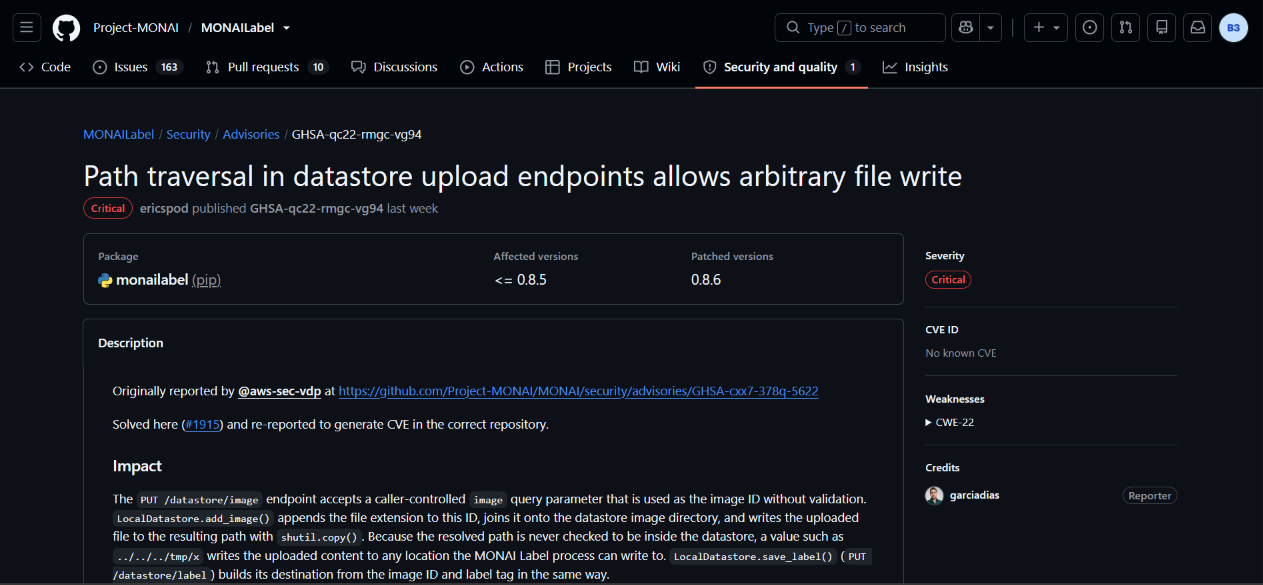
Under the hood, MONAI Label appended that caller-supplied filename directly to its local storage folder path without checking whether the text stayed inside that directory. By inserting directory traversal characters such as ../ into the filename, a remote client could force the server to escape its image storage folder and write files anywhere on the operating system that the MONAI Label process had permission to touch.
The 11-minute figure reported by Amazon measures the time it took the agents to move from mapping MONAI Label’s API endpoints to confirming they could write arbitrary files outside the datastore directory. Arbitrary file writing does not automatically execute commands on a server, so the agents chained the flaw with a second step in a follow-up session.
To turn file access into remote code execution, the agents overwrote sitecustomize.py, a special Python configuration file that automatically runs whenever a new Python program starts on the machine. Once that file contained a remote connection script, the agents triggered MONAI Label’s model-training feature, causing the server to launch a new Python process and execute the attacker’s code. Because the university server was running MONAI Label with root privileges, the resulting remote shell gave full system control.
How the exploit unfolded
Crafted upload request
A path traversal sequence bypassed the intended directory.
Python file overwritten
The attacker wrote code outside the datastore directory.
Root shell obtained
A later training request triggered the modified Python startup file.
Timing: The reported 11 minutes covered API mapping to arbitrary file writing, not the complete root-shell sequence.
What the AI Did Alone, and Where Humans Stepped In
Public headlines often blur the line between software that assists human hackers and software that operates completely on its own. The logs from the exposed Cairn server show a clear division between machine execution and human direction.
The AI agents acted independently during reconnaissance, hypothesis testing, and exploit chaining. Before reaching MONAI Label during a roughly 48-hour campaign that began on September 8, the same agents spent about 16 hours and 148 steps trying and failing to compromise a Redis database server, and tested more than 30,000 password combinations across roughly 80 usernames against a university graphics-processing server without success. When they pivoted to the MONAI Label host, the agents independently spotted the upload parameter, tested path traversal sequences, and figured out how to abuse Python’s startup behavior to obtain a shell.
Human operators still defined the boundaries of the operation. A human supplied the target list of university IP addresses outside mainland China and gave the agents the high-level goal to obtain shell access. Later, after the agents compromised the initial MONAI Label server, a human operator stepped in to provide a network proxy tunnel into a second university network running the same software so the agents could repeat the attack.
Amazon Threat Intelligence assessed with moderate confidence that a China-nexus threat actor ran the campaign, pointing to operator prompts written in Simplified Chinese, script timestamps configured to China Standard Time, and the selection of East Asian university targets outside mainland China. Because attribution relies on operational artifacts from an exposed server rather than confirmed operator identities, it remains an intelligence assessment rather than proven fact.
Two additional details from the incident carry broader lessons for software maintainers and defenders. First, the compromise was made possible by an insecure default configuration: both the victim’s MONAI Label server and the attacker’s own Cairn server shipped with authentication disabled by default. Second, the timeline between code repair and public software packaging exposed a common gap in open-source maintenance.
After Amazon privately reported the flaw, Project MONAI maintainers merged a source-code fix in Pull Request #1915 on October 19, 2026. However, the project published its public security advisory (GHSA-qc22-rmgc-vg94) on November 18, four days before releasing the patched MONAI Label 0.8.6 package on GitHub and PyPI on November 22. During that gap, anyone installing the software through standard package managers still received vulnerable version 0.8.5 unless they manually built the unreleased source code.
Even in its follow-up 0.8.7 security release, which fixed additional critical remote code execution (GHSA-j5c7-p3x5-gw2x) and path traversal (GHSA-cqpr-79vx-xr5x) bugs affecting versions up to 0.8.6, Project MONAI kept authentication turned off by default (MONAI_LABEL_AUTH_ENABLE=False). Instead, the maintainers warned administrators in the release notes not to expose the server to untrusted networks.
It is equally important to separate confirmed harm from potential risk. Confirmed exploitation affected university research servers, and no public evidence indicates that clinical hospital networks or live patient medical records were accessed or stolen. Still, because MONAI Label is widely used in academic medical imaging labs, an unpatched server exposed to the internet or a campus network faces immediate risk of full takeover.
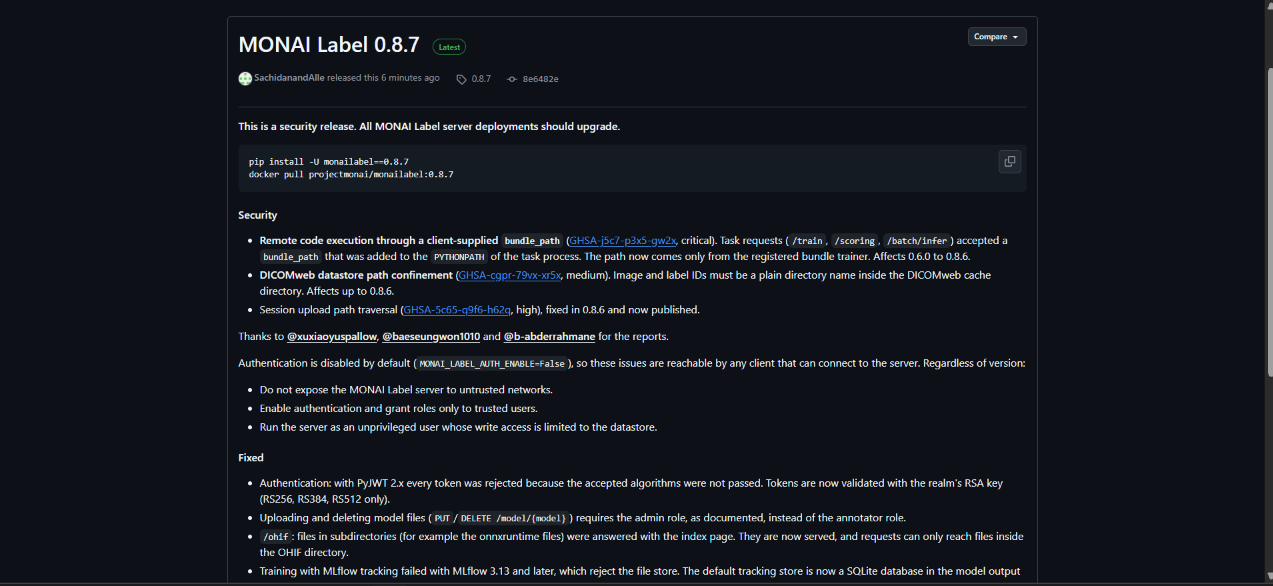
Organizations running MONAI Label 0.8.5 or earlier should upgrade immediately and because Project MONAI subsequently issued version 0.8.7 to patch additional critical remote code execution (GHSA-j5c7-p3x5-gw2x) and DICOMweb path traversal (GHSA-cqpr-79vx-xr5x) flaws affecting releases up to 0.8.6, administrators should update directly to 0.8.7 or later. Administrators should never expose MONAI Label directly to the public internet, should enable authentication (MONAI_LABEL_AUTH_ENABLE=True), should avoid running the service as root, and should inspect servers for unexpected sitecustomize.py files or unauthorized modifications.



Community discussion
Join the conversation
0 comments
Be the first to join in
There are no comments yet. Sign in to start a thoughtful discussion.
Sign in to comment
Join the conversation with your Secritic account. Comments are available to signed-in readers.