
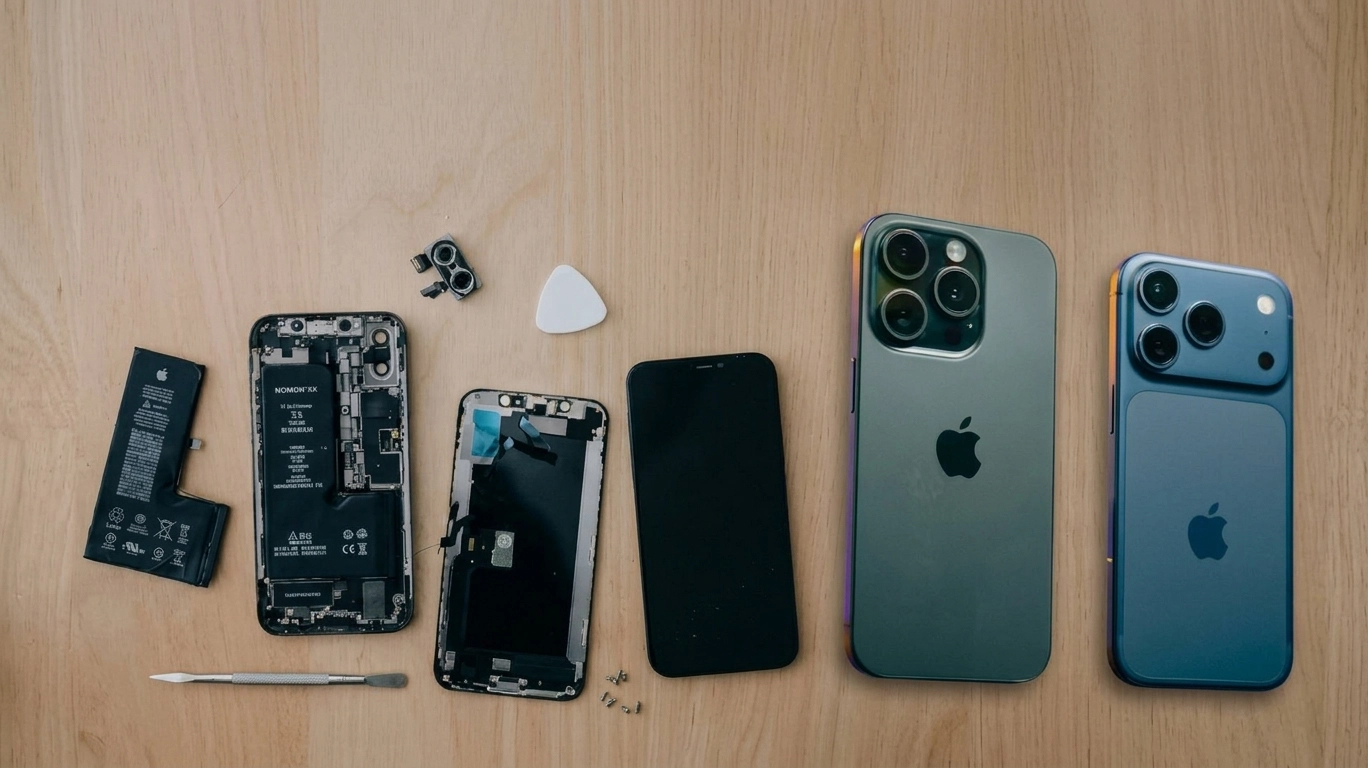
Apple is now selling official replacement parts for the iPhone 18 Pro and iPhone 18 Pro Max, as well as newer Mac mini and Mac Studio models. The expansion gives experienced owners another way to repair their devices without relying entirely on a service provider.
But there is a catch. Buying a replacement part is not the same as paying for a completed repair.
A replacement display for the iPhone 18 Pro has been reported at $329 in the US. If you also need Apple’s $49 toolkit rental, the initial total reaches $378 before shipping, taxes, or any additional materials. For the iPhone 18 Pro Max, the same calculation reaches $428.
That does not mean a professional repair will always cost less. It does mean that anyone considering a DIY repair needs to look beyond the price of the part.
There is another reason to be careful. In a September teardown, repair specialists at iFixit reported that the plastic frame around the iPhone 18 Pro’s display cracked or separated during three of the four phones they opened. The finding raises a practical question for owners: could the process of opening the phone turn a straightforward repair into a more expensive job? iFixit cautioned that its small sample was not enough to establish how widespread the problem might be.
The bigger question is whether you can fix your device safely, complete the required steps, and spend less than you would on a comparable professional repair.
Which Apple devices can you repair yourself?
According to reports published on October 20, 2026, Apple’s Self Service Repair Store has added replacement parts for the iPhone 18 Pro and iPhone 18 Pro Max, alongside newer Mac mini and Mac Studio models.
The iPhone parts include displays, batteries, camera assemblies, back glass, speakers, enclosures, logic boards, microphones, SIM trays, and Taptic Engines. The exact selection depends on the model and the component.
For supported Mac models, the available parts include components such as fans, speakers, power supplies, ports, and logic boards. Storage modules are also available for certain configurations.
Apple provides model-specific repair manuals that explain the procedure and identify the required parts, tools, and materials. Some components may require a device serial number or IMEI when ordering.
This is useful for owners who want more control over repairs. However, Apple’s programme is not designed as a beginner’s introduction to electronics repair. Apple says it is intended for people who already have the knowledge and experience needed to work on electronic devices.
That distinction matters before you spend money on a part you may not be comfortable installing.
What do the replacement parts actually cost?
Reported prices from the US Self Service Repair Store give an idea of the initial expense.
Apple Self Service Repair
What Do iPhone 18 Pro Repair Parts Cost?
Reported US prices for selected replacement components and the tool kit needed to carry out a repair yourself.
| Replacement part or tool | Reported price |
|---|---|
| iPhone 18 Pro display Screen assembly | $329 |
| iPhone 18 Pro Max display Larger model screen assembly | $379 |
| Camera assembly | $249 |
| Battery | $129 |
| Back glass | $159 |
| Front camera | $199 |
| Repair toolkit rental Seven-day rental | $49 |
Important: These are reported US prices, not a guaranteed checkout quote. Availability, shipping, taxes, model compatibility and return-credit eligibility may vary. The toolkit rental is a separate cost.
These are reported US prices, not universal prices or complete repair quotes. The parts available, shipping charges, taxes, and additional materials may differ by location and repair type.
There is another detail worth checking before ordering: Apple may offer a credit when certain replaced components are returned. According to the published price reporting, returning an eligible original camera could qualify for a $59.76 credit, reducing its effective cost from $249 to $189.24.
The reported battery credit is also substantial. A $129 battery could cost an effective $67.08 after a qualifying $61.92 credit.
However, a return credit should not be treated as an automatic discount. Customers should check the current store listing, eligibility rules, and return instructions for the exact part they intend to replace.
The important point is that two repairs with similar advertised prices may have different final costs. The part price is only the starting point.
A screen repair could start at $378
Consider an owner whose iPhone 18 Pro display needs replacing. They do not already own the necessary specialist tools, so they decide to rent Apple’s toolkit.
Based on the reported US prices, the initial calculation looks like this:
The real cost of DIY
A Screen Repair Costs More Than the Screen
Add Apple’s reported seven-day toolkit rental to the listed display price to see the initial cost before other expenses.
6.3-inch model
iPhone 18 Pro
6.9-inch model
iPhone 18 Pro Max
Before you buy: These totals exclude shipping, taxes, any additional materials and other incidental costs. Eligible returned parts may qualify for a credit, subject to Apple’s conditions. These figures are not a final repair quote.
These totals are calculations using the reported display prices and toolkit rental. They are not prices quoted by Apple for a complete repair.
They also exclude shipping, taxes, and any additional materials required. A qualifying return credit could reduce the effective cost, while an owner who already has suitable tools might avoid the rental charge altogether.
This is why a simple comparison between a replacement screen and a professional repair can be misleading. The fair comparison is the full DIY cost against a quote for the same repair, on the same model, from a professional provider.
If a repair shop offers a comparable service for a similar total, paying for professional labour may be worthwhile. If the DIY route is substantially cheaper and the owner has the right skills, doing the repair themselves could make more sense.
Without comparable quotes, however, it would be misleading to declare either option the cheaper one.
The repair can go wrong before you even open the phone
One of the easiest mistakes is ordering a replacement part before confirming what is actually broken.
A cracked display may clearly need replacing, but other problems can be less obvious. A phone that will not charge, for example, could have a problem involving the charging connection, battery, or another component. Replacing the wrong part would add an unnecessary expense without solving the original problem.
Apple’s iPhone 18 Pro repair manual includes troubleshooting guidance for issues involving the battery, charging, power, camera, display, sound, and other functions. It also provides procedures for individual component replacements.
Reading the relevant sections before ordering can help you understand the symptoms, identify the appropriate repair, and find out what the work involves.
There is still a limit to what a manual can do. If you cannot confidently identify the fault, a diagnostic assessment may be a better first step than buying a component and hoping it fixes the problem.
What a real iPhone teardown reveals about repair risks
The price of a replacement part does not tell you how difficult it will be to reach that part inside a phone. A hands-on teardown can reveal problems that are not obvious from a store listing.
On September 20, 2026, iFixit published a teardown of the iPhone 18 Pro and iPhone 18 Pro Max by Elizabeth Chamberlain, with Carsten Frauenheim. The team examined the phones’ internal components, including the new variable-aperture camera system, cooling hardware, and battery assembly.
One finding deserves particular attention: the plastic frame around the display cracked or separated during three of the four phones the team opened.
This matters because the display is more than a panel that shows images. It is also the entry point for many repairs.
According to iFixit’s teardown, reaching the battery requires removing the glued-down display. Although the battery tray itself is secured with screws, getting to it means first dealing with the screen and its adhesive.
In other words, a repair that begins with a battery problem can involve a risk to a different, potentially expensive component before the battery is even accessible.
A damaged display frame can also create problems during reassembly. iFixit explained that a broken frame may prevent the screen from sitting properly and could compromise the phone’s water resistance.
That does not mean every iPhone 18 Pro screen will break during repair. The team examined only four phones, and such a small sample cannot establish a general failure rate. The finding is a documented warning from a hands-on investigation, not proof that all devices share the same defect.
The camera presents a different challenge. iFixit’s examination of the variable-aperture mechanism showed how small and intricate its moving parts are. During disassembly, the team found that the mechanism was not straightforward to take apart and reassemble. If a tiny internal component is damaged, replacing an individual piece may be impractical compared with replacing the camera assembly.
These observations help explain an important difference: a component can be replaceable without being easy or inexpensive to repair.
For someone with experience, the official manual and correct tools may make the job manageable. For a first-time repairer, the same job could carry additional risks and costs.
The teardown does not establish what every repair will cost, and it does not prove that Apple’s programme is poor value. It provides real-world evidence that should be considered alongside the advertised part prices.
Why a replacement part is not the whole repair
Modern smartphones contain delicate connectors, tightly packed components, and parts held in place with adhesives. Some procedures require specialised equipment and careful handling.
A mistake can damage a connector, another component, or the replacement part itself. If that happens, the original repair may become more expensive, and you could still need professional assistance.
There is also the time involved. Someone experienced with electronics may be comfortable following a detailed manual. A first-time repairer could need considerably longer to understand the instructions, organise the tools, and complete the procedure.
Time does not appear on the parts invoice, but it still matters when deciding whether a repair is practical.
This is not an argument against DIY repairs. It is a reason to assess the work honestly before committing to it.
The repair may not be finished when the phone is reassembled
Another detail that is easy to miss is the software process after a physical repair.
Apple explains that some repairs may require post-repair steps using tools such as Repair Assistant or System Configuration. The relevant repair manual indicates when a software tool is recommended.
The exact requirements depend on the device and the component being replaced. Readers should therefore follow the instructions for their specific model rather than assume every repair follows the same process.
This matters because successful repair involves more than fitting a new component. The device must also function correctly once the work is complete.
Before ordering anything, check the full procedure, including any steps required after reassembly. It is better to discover those requirements before starting than to encounter an unexpected hurdle at the end.
Does buying genuine Apple parts make DIY repair worthwhile?
Genuine parts and official manuals have clear advantages. They give customers access to components supplied for the relevant device and instructions written for supported repair procedures.
However, genuine does not automatically mean inexpensive, and official documentation does not make every repair easy.
The right choice depends on the repair itself. A person who has suitable tools and experience may find the programme useful. Someone unfamiliar with electronics may decide that a professional repair is worth the additional labour cost.
It is also important not to assume that every cheaper third-party part is unsuitable. Instead, check its compatibility, condition, seller reputation, warranty terms, and any limitations that could affect the repair. Compare like with like before deciding which option offers better value.
The central issue is not simply whether a part is genuine. It is whether the complete repair meets your needs at an acceptable cost.
What this means for UK readers
The prices above are reported US prices. They should not be converted directly into pounds and presented as the price a UK customer will pay.
Regional prices, taxes, shipping, and the availability of individual components can differ. UK readers should check Apple’s current Self Service Repair guidance and the relevant store listing before ordering.
It is also worth obtaining a quote from Apple or an Apple Authorised Service Provider. If you consider an independent repair shop, ask which parts it will use, what warranty applies to the work, and whether the quoted price includes everything required.
Check the terms of any applicable warranty or service plan before opening your device. Do not assume that a self-repair will be treated in the same way as work carried out by Apple or an authorised provider.
Battery safety deserves particular attention. If a battery is swollen or visibly damaged, do not attempt an improvised repair. Damaged lithium-ion batteries can cause fires or injuries if handled incorrectly.
How to decide whether DIY repair is worth it
Before ordering a replacement part, work through these five questions:
- Do you know what is broken? If the cause is uncertain, investigate the fault before paying for a component.
- Have you read the correct repair manual? Check the procedure, tools, materials, and any post-repair steps for your exact model.
- What is the complete cost? Include the part, tool rental or purchase, supplies, shipping, and taxes. Account for a return credit only if your component qualifies.
- How does it compare with professional repair? Get a quote for the same device and fault so you can compare the actual costs.
- Are you confident you can complete the job? If the procedure exceeds your experience, consider whether the possible savings justify the risk.
If the DIY option is clearly cheaper and you have the necessary skills, it may be a sensible choice. If the difference is small, or the procedure is unfamiliar, paying for professional help may offer better value.
The bigger question is whether repair is practical
Apple’s latest expansion gives owners another way to obtain official parts for supported devices. That is a useful development, particularly for experienced users who want to keep their devices working for longer.
But repairability involves more than making parts available. It also depends on their price, the tools and instructions required, access to diagnostic information, and the ability to complete the work successfully.
Repair advocacy organisation iFixit describes repairability as a wider system involving parts, tools, documentation, disassembly, and software. Its teardown of the iPhone 18 Pro illustrates why this broader view matters: a replacement battery may be available, but accessing it still requires opening a phone whose display frame the team found vulnerable to damage during its limited testing.
The European Commission’s repair rules provide a broader consumer context, too. The EU’s Directive on common rules promoting the repair of goods has applied from July 31, 2026, with requirements intended to encourage repair and improve access to repair services and spare parts for products within its scope. These rules do not mean every repair must be free or that every product is covered in the same way.
That is the bigger issue for consumers. A device is easier to keep for longer when repairs are not only technically possible, but also practical and affordable.
Apple’s programme offers more options, but it does not guarantee that DIY repairs will save every owner money. For some people, the cost and effort will make sense. For others, a professional repair may be the better decision.
Before buying a replacement part, calculate the full cost and understand the work involved. The best repair is not simply the one you can do yourself. It is the one that gets your device working safely and reliably for a price that makes sense.
Sources
- Apple Self Service Repair guidance for the UK
- Apple’s official iPhone 18 Pro repair manual
- 9to5Mac’s report on the newly available repair parts and reported US prices
- GSMArena’s report on US prices and return credits
- MacRumors’ report on supported devices and regions
- iFixit’s iPhone 18 Pro and Pro Max teardown by Elizabeth Chamberlain, with Carsten Frauenheim
- iFixit’s explanation of repairability
- iFixit’s Right to Repair overview
- European Commission: New consumer rights for easy and attractive repairs
- European Commission: Directive on repair of goods



Community discussion
Join the conversation
0 comments
Be the first to join in
There are no comments yet. Sign in to start a thoughtful discussion.
Sign in to comment
Join the conversation with your Secritic account. Comments are available to signed-in readers.